Quick Summary
- Standing all day and vein disease are closely linked: prolonged, largely motionless standing lets blood pool in the lower legs and raises pressure inside vein valves.
- Occupational research consistently ranks prolonged standing among the strongest workplace risk factors for varicose veins and chronic venous insufficiency, often outweighing prolonged sitting.
- Retail, hospitality, healthcare, education, and personal-service workers across Manhattan, Manhasset, and Commack are among those most affected.
- Aching, heaviness, ankle swelling, and visible veins that build through a shift and ease after rest are common early warning signs.
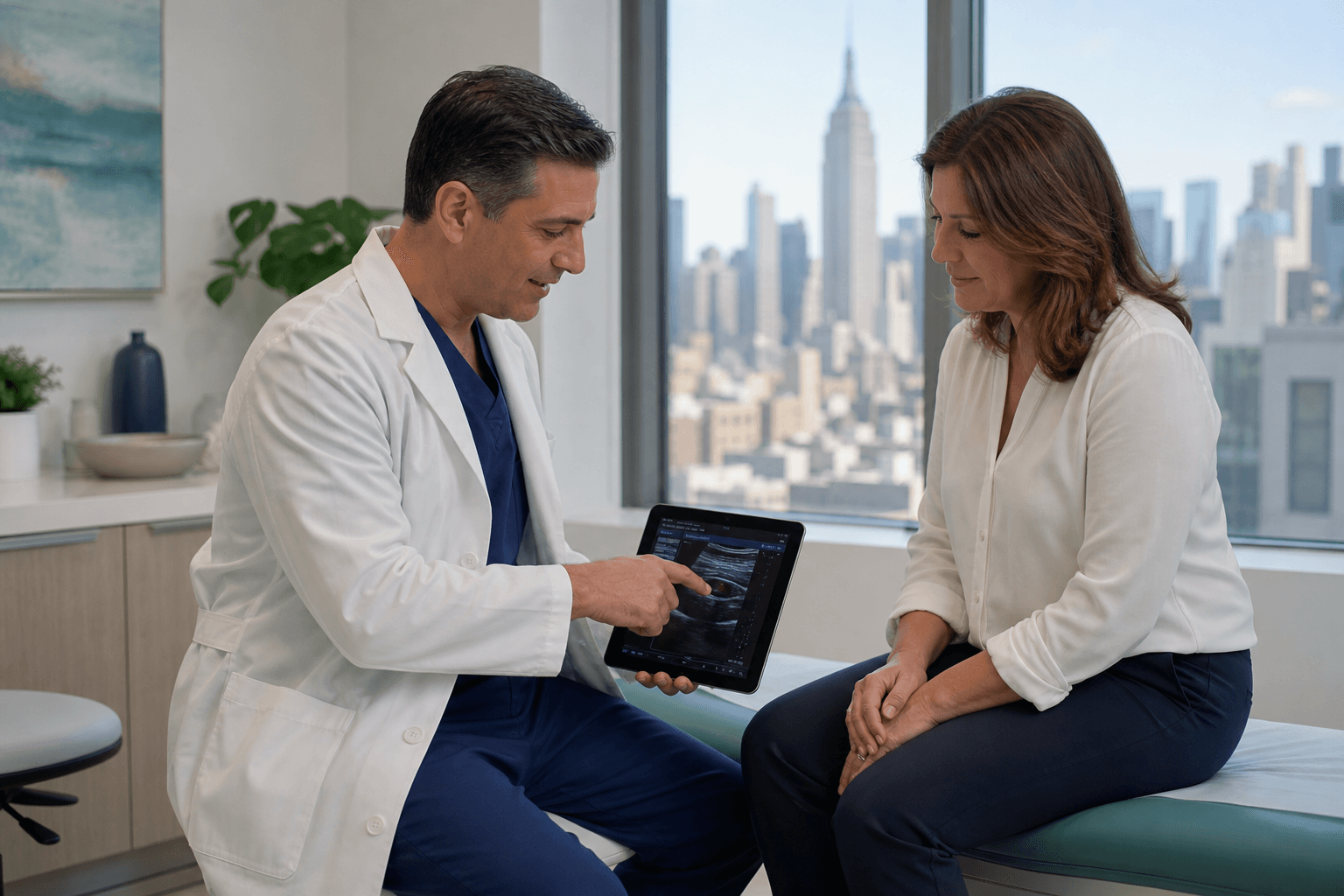
- A physician-led duplex ultrasound evaluation can confirm whether venous reflux is contributing to standing-related leg symptoms.
Standing all day is one of the most consistently documented occupational risk factors for varicose veins and chronic venous insufficiency, because it allows blood to pool in the lower legs for extended periods.
What Happens in Your Veins When You Stand All Day
Standing all day and vein disease are two things many New York workers experience together without recognizing the connection. If your job keeps you on your feet — behind a retail counter, at a nurses' station, in a classroom, or on a restaurant floor — you may notice your legs feel heavier, more swollen, or more visibly veined by the time your shift ends than they did that morning. That pattern is not simply fatigue. Prolonged standing is one of the most consistently documented occupational risk factors for varicose veins and chronic venous insufficiency (CVI), the condition in which faulty vein valves allow blood to pool in the lower legs instead of returning efficiently to the heart.
At Schulman Vein and Laser Center, we regularly evaluate New York patients whose leg symptoms track closely with their work schedule, from Manhattan retail floors to hospital units and salons across Long Island. This guide explains why standing all day raises vein disease risk, which occupations are affected most, and when on-the-job leg symptoms are worth a physician-led evaluation as part of our vein disorders and conditions care.
Standing without much movement reduces the calf muscle pump's ability to move blood out of the legs, raising venous pressure over time — a well-documented driver of varicose veins and chronic venous insufficiency.
How Standing All Day and Vein Disease Are Connected

Your leg veins rely on more than the heart to move blood upward. Every time your calf muscles contract — while walking, climbing stairs, or shifting your weight — they squeeze the deep veins in your leg and push blood toward the heart, assisted by one-way valves that prevent it from flowing backward. This mechanism is often called the calf muscle pump, and it is far less active when you stand still for long stretches.
When you stand largely motionless for hours, the calf muscle pump barely engages, and blood has more time to pool in the lower leg. That pooling raises pressure inside the vein walls and valves, a state clinicians call venous hypertension. Over months and years of repeated exposure, this elevated pressure can stretch and weaken vein valves, allowing blood to flow backward — the process behind chronic venous insufficiency and the varicose and spider veins that often come with it.
Published occupational health research consistently identifies prolonged standing as one of the strongest workplace risk factors for venous disease, in several studies a stronger predictor than prolonged sitting. The effect tends to be cumulative: the more consecutive years a job requires standing, the higher the reported prevalence of varicose veins and CVI symptoms among workers in that field.
Standing itself does not have to be a health hazard. The risk comes from standing largely still, for long uninterrupted stretches, without the movement that activates your calf muscle pump.
Retail, hospitality, healthcare, education, and personal-service jobs across Manhattan, Manhasset, and Commack are among the occupations most consistently linked to standing-related vein disease.
New York's On-Your-Feet Workforce: Who's Most at Risk
Certain occupations require standing for the majority of a shift, and New York's economy has no shortage of them. Retail associates, hospitality and restaurant staff, hairstylists and salon workers, security and door staff, teachers, and healthcare workers such as nurses and surgical staff are among the occupations most frequently studied for standing-related vein disease.
- Retail and hospitality workers on Manhattan sales floors and in restaurants, often standing through shifts of 8 hours or more
- Nurses and other healthcare staff across New York hospitals and clinics, frequently combining long standing periods with heavy lifting
- Teachers, who typically stand and walk classroom aisles for most of the school day
- Hairstylists, barbers, and salon professionals, who stand in one position for extended appointments
- Security staff, doormen, and hospitality workers in Manhattan, Manhasset, and Commack who remain on their feet for extended shifts
If your job checks more than one of these boxes — long shifts, minimal seated breaks, and years in the same role — your cumulative exposure to standing-related vein pressure is higher than someone earlier in a standing career.
Leg symptoms that build predictably through a standing shift and ease after elevation or rest are a common pattern in early standing-related vein disease.
Early Warning Signs to Watch For During Your Shift
Standing-related vein symptoms often follow a recognizable daily pattern: mild in the morning, building through a shift, and easing somewhat overnight after your legs have been elevated during sleep. Recognizing that pattern early can prompt an evaluation before symptoms become more persistent.
- Aching, heaviness, or fatigue in the legs that builds as your shift goes on
- Ankle or lower-leg swelling that is noticeably worse by the end of the day
- Visible spider veins or bulging varicose veins, especially behind the knee or along the inner calf
- A throbbing or cramping sensation after several hours on your feet
- Itching or mild skin discoloration over the lower leg, discussed further in our guide to itchy legs and vein disease
Persistent or worsening standing-related symptoms, or any sudden one-sided swelling or calf pain, warrant prompt medical evaluation rather than being dismissed as ordinary job fatigue.
When Standing-Related Leg Symptoms Need Prompt Care
Ordinary end-of-shift heaviness or mild swelling is common and not an emergency on its own. Contact your physician if symptoms persist despite rest and elevation, worsen over successive shifts rather than resolving on days off, or are accompanied by skin changes such as thickening, discoloration, or a wound that will not heal — details covered further in our guide to leg swelling and vein disease.
Sudden one-sided leg swelling, redness, warmth, or calf pain is different from ordinary standing fatigue and should not be assumed to be work-related. Seek prompt medical evaluation, since these can be signs of a blood clot. Call emergency services for chest pain or shortness of breath.
Movement breaks, properly fitted compression stockings, leg elevation, and supportive footwear all reduce venous pressure during standing shifts, though they do not replace evaluation for existing vein disease.
Practical Steps to Protect Your Veins at Work
While a physician-led evaluation is the only way to know whether venous reflux is present, several practical habits can reduce venous pressure during a standing shift.
- Shift your weight and take short walking breaks when your role allows, to re-engage the calf muscle pump
- Wear graduated compression stockings suited to your shift length; our guide to compression stockings and vein health explains how to choose the right fit
- Elevate your legs above heart level when you get home, even for 15–20 minutes
- Stay hydrated and maintain a healthy weight, both of which support venous return
- Choose supportive, properly fitted footwear over unsupportive shoes for long shifts
Simple calf raises or ankle pumps performed every 30 to 60 minutes during a shift can meaningfully increase blood flow out of the lower legs.
Diagnosis relies on duplex ultrasound, and most confirmed cases are treatable with minimally invasive, in-office procedures that allow a prompt return to standing work.
How Vein Disease From Prolonged Standing Is Diagnosed and Treated
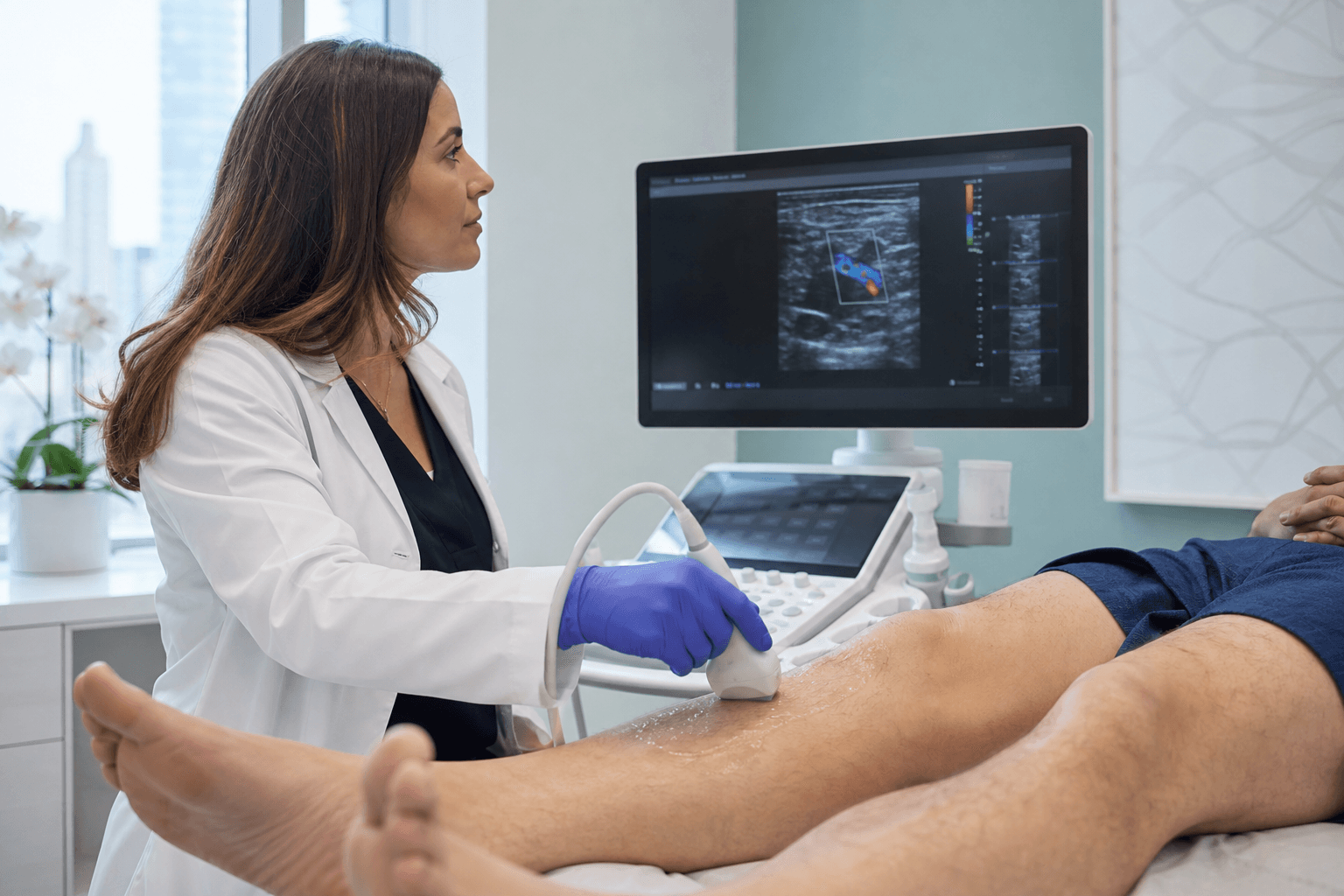
A vein evaluation for standing-related symptoms begins with a physical examination and a review of your work history, shift length, and symptom pattern. Duplex ultrasound is the standard next step: a painless imaging test that maps the veins in your leg and measures the direction of blood flow to confirm whether venous reflux is present and how severe it is.
When reflux is confirmed and treatment is appropriate, most patients today are candidates for minimally invasive, in-office procedures rather than traditional surgery, including radiofrequency ablation, VenaSeal, and sclerotherapy for varicose and spider veins. These procedures are performed under local anesthesia, and most patients return to work — including standing jobs — within a day or two, following their physician's specific guidance.
Treating the underlying diseased vein, rather than compression alone, is generally the most effective way to reduce recurring standing-related symptoms over the long term.
Book a Free Vein Screening in New York
If your legs consistently ache, swell, or show visible veins after standing shifts, don't wait for symptoms to worsen. Schulman Vein and Laser Center provides physician-led evaluations, including duplex ultrasound, at three New York locations serving Manhattan, Nassau County, and Suffolk County.
Book a Free Vein Screening to have your legs evaluated. Call Manhattan at 212.987.0500, Manhasset at 516.482.4477, or Commack at 631.543.4599. This article is educational and does not replace an in-person medical evaluation.
Frequently Asked Questions
Can standing all day at work really cause vein disease?
Prolonged standing is one of the most consistently documented occupational risk factors for varicose veins and chronic venous insufficiency, because it reduces how often your calf muscle pump moves blood out of the legs. It is a risk factor rather than a guaranteed outcome — many people who stand for a living never develop vein disease, and factors like genetics, age, and pregnancy also play a role.
Which jobs carry the highest risk of vein disease from standing?
Occupational research most often points to retail and hospitality workers, nurses and other healthcare staff, teachers, and hairstylists — roles common across Manhattan, Manhasset, and Commack that require standing through most of a shift with limited seated breaks.
Do compression stockings help if I stand all day at work?
Graduated compression stockings are commonly recommended to support venous return during long standing shifts, and many patients find they reduce end-of-day heaviness and swelling. Fit and pressure level should be individualized, so review your options with a physician rather than choosing over-the-counter compression on your own.
How do I know if my leg symptoms from standing need medical attention?
Ordinary end-of-shift heaviness that improves with rest and elevation is common. See a physician if swelling or aching persists despite rest, worsens over successive shifts, or comes with visible varicose veins, skin discoloration, or a wound that won't heal. Sudden one-sided swelling or calf pain needs prompt evaluation.
Can I keep working a standing job after vein treatment?
Most patients treated with minimally invasive procedures such as radiofrequency ablation, VenaSeal, or sclerotherapy return to normal activity, including standing jobs, within a day or two. Your physician will give you guidance specific to your procedure and recovery.
Related Treatment Resources
Need Personalized Vein Care?
Schedule a physician-led evaluation and review treatment options tailored to your symptoms and goals.