
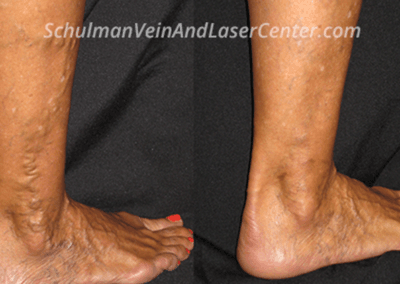
Varicose veins are often a visible symptom of a deeper circulation problem — venous insufficiency — not just a cosmetic concern.
What varicose veins actually are
Varicose veins develop when vein valves in the legs weaken and allow blood to pool instead of returning efficiently to the heart. The pressure stretches the vein wall over time, making veins look twisted, enlarged, or rope-like.
Many people assume varicose veins are only cosmetic — but visible veins can be one sign of chronic venous insufficiency. The underlying circulation problem may be present even when discomfort seems mild or manageable.
Symptoms patients should not ignore
Common symptoms include leg heaviness, aching after prolonged standing, ankle swelling, nighttime cramping, and itching around visible veins. Some patients also report restlessness or fatigue in the legs at the end of a long New York workday.
If symptoms worsen despite leg elevation, compression, or routine activity changes, a diagnostic duplex ultrasound can clarify whether venous reflux is present and whether treatment may help.
- Heaviness or aching in legs, especially after standing
- Ankle or lower-leg swelling that worsens throughout the day
- Nighttime cramping or restless legs
- Itching, burning, or throbbing near visible veins
- Skin discoloration or dryness near the ankles
- Visible bulging veins that are worsening over time
If you notice sudden leg pain, warmth, or redness along a vein, seek prompt medical evaluation. These symptoms can occasionally signal a blood clot and should not be managed with watchful waiting.
You do not have to wait until symptoms are severe. Scheduling a vein screening early is low-risk and often reduces the complexity of eventual treatment.
When to schedule an evaluation
An evaluation is appropriate when symptoms interfere with daily life, visible veins are progressing, or skin changes are appearing around the lower leg.
Early treatment can help limit progression and reduce long-term complications. Patients throughout Manhattan, the Upper East Side, and Long Island often delay evaluation until symptoms become severe — but intervening earlier typically means simpler treatment and faster recovery.
At Schulman Vein and Laser Center, a free vein screening is the fastest way to understand whether an evaluation is the right next step.
- Symptoms are affecting your daily activity or sleep
- Visible veins have increased in size or number over months
- Skin near the ankle is darkening, hardening, or developing sores
- You have a family history of vein disease
- Previous treatment did not fully resolve symptoms
How treatment planning usually works
Treatment is selected based on ultrasound findings and symptom profile, not just appearance. Depending on anatomy, options may include endovenous laser therapy, sclerotherapy, microphlebectomy, or staged combination care. Visit our varicose vein treatment page for a full overview of available approaches.
Most modern procedures are minimally invasive and performed in-office. Patients can usually walk immediately afterward and return to normal activity quickly with specific aftercare instructions.
At Schulman Vein and Laser Center, every treatment plan is developed personally by a physician — never a technician or nurse-only team.
- Duplex ultrasound maps vein anatomy before any treatment decision
- In-office procedures — no hospital stay required
- Walking encouraged immediately after most procedures
- Follow-up ultrasound confirms closure and monitors results
- Staged plans address both deeper reflux and surface cosmetic veins
What to expect at a Schulman vein screening
A free vein screening at Schulman Vein and Laser Center includes a physician consultation, review of your symptoms, and an initial assessment of your vein condition.
If ultrasound mapping is recommended, the team will schedule a diagnostic study and walk you through insurance verification before any procedure is planned.
We serve patients from Manhattan, Midtown, the Upper East Side, Manhasset, Commack, and surrounding communities across Nassau and Suffolk counties.
Bring a list of any medications, compression garments you currently use, and your insurance card to your screening appointment. This helps the physician give you the most complete guidance on your first visit.
Related Treatment Resources
Need Personalized Vein Care?
Schedule a physician-led evaluation and review treatment options tailored to your symptoms and goals.